I'm For You (User Friendly)
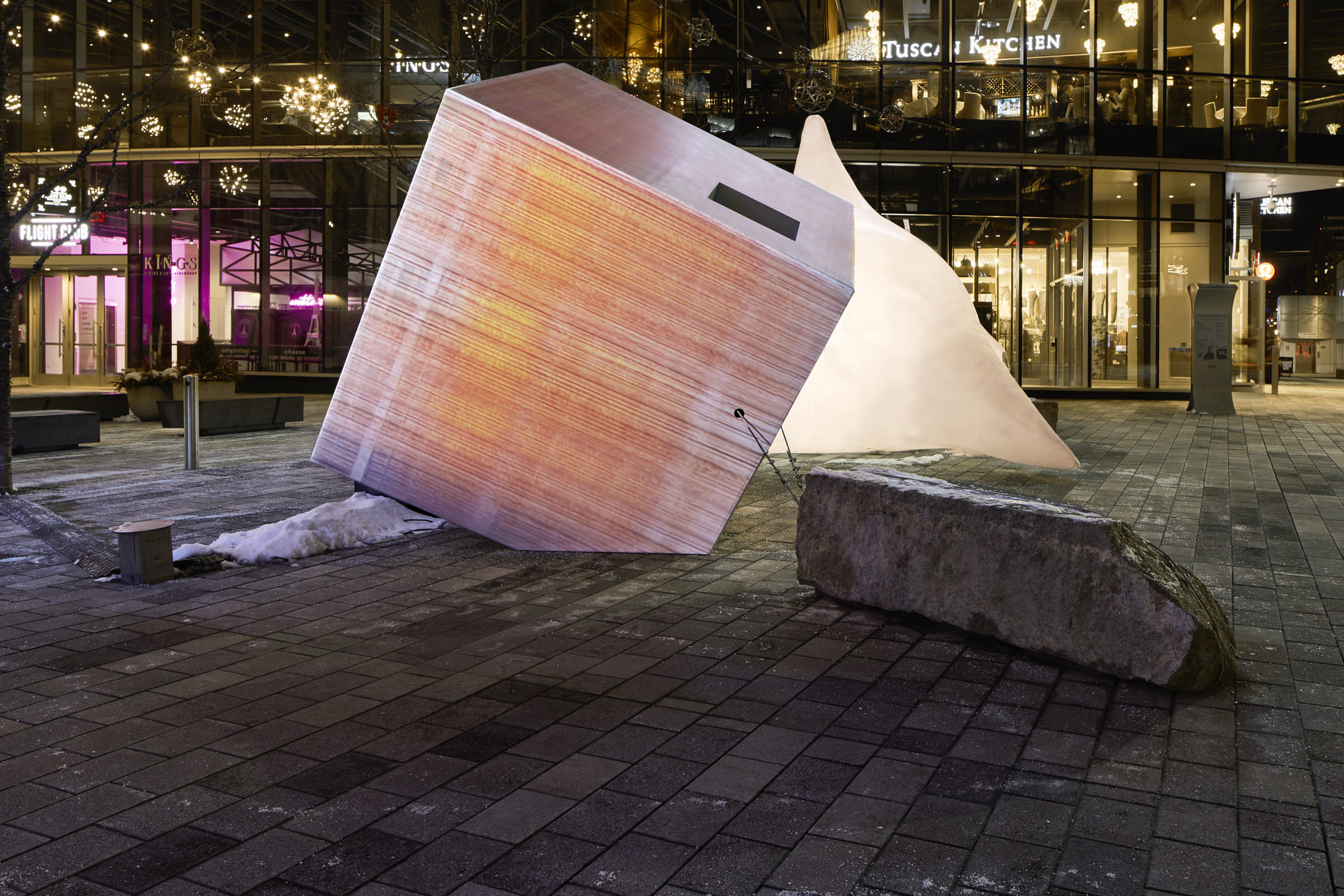
Public Realm Installation (Design Biennial Boston), 2021
This highly visible public realm installation was a reflection on real and imagined relationships between places, people, and their machines. The design-build project, awarded to Supernormal upon winning the Design Biennial, explored physical and digital closeness in the public realm in a year characterized by social distancing, systemic loneliness and political polarization. The work presented itself in two parts: a soft, corporeal form held a silent conversation with a generic box that used dynamic projection mapping to continuously transform for its viewers. The changing surface of the box displayed the output of an artificial intelligence model trained on Seaport building façades to generate an imagined fragment of Boston’s Seaport that alternately mimicked, complimented and challenged its surroundings. The interactive piece occupied the public realm during the shortest, coldest days of the year. It was designed to be most alive, engaging, and visible during the darkest and longest nights, when light is most scarce.
Learn more about the project here.
The installation, entitled I’m for You (User Friendly), was executed as a design-build project on a very tight budget. The significant challenges involved in assembling multiple points of highly accurate projection mapping in the public realm was a risk worth taking for this highly dynamic and interactive outcome.
In order to train the machine learning model that drives the projection content, the design team created a robust data set of building façades within the Seaport (below, left). The output of the trained model (below, right) is an amplified and abstract rehearsal of the patterns that already exist within the culture of design over the past decade in this “innovation district.” The output of the AI model is assembled into a dynamic animation projected as a looped sequence of smooth transitions between machine-imagined façades. The images at right capture moments within the projected animation sequence. They are screen shots from the software guiding the projection from the buildings abutting the exterior installation. The installation interacts with pedestrians. As pedestrians linger near the installation the inflatable lighting grows warm and bright and the animation transitions increase in speed.
Role: Design Director
Award: Design Biennial Boston, 2020

 Stills of rolling machine learning model output from projection coordination software.
 A brief clip from the animated output of the machine learning model.
 The training set (above) is composed of images of all building facades in Boston's Seaport.
The output (below) is an endless automated Seaport building facade.
The training set (above) is composed of images of all building facades in Boston's Seaport.
The output (below) is an endless automated Seaport building facade.

