Living with Water
Designing for Urban Climate Migration, 2015
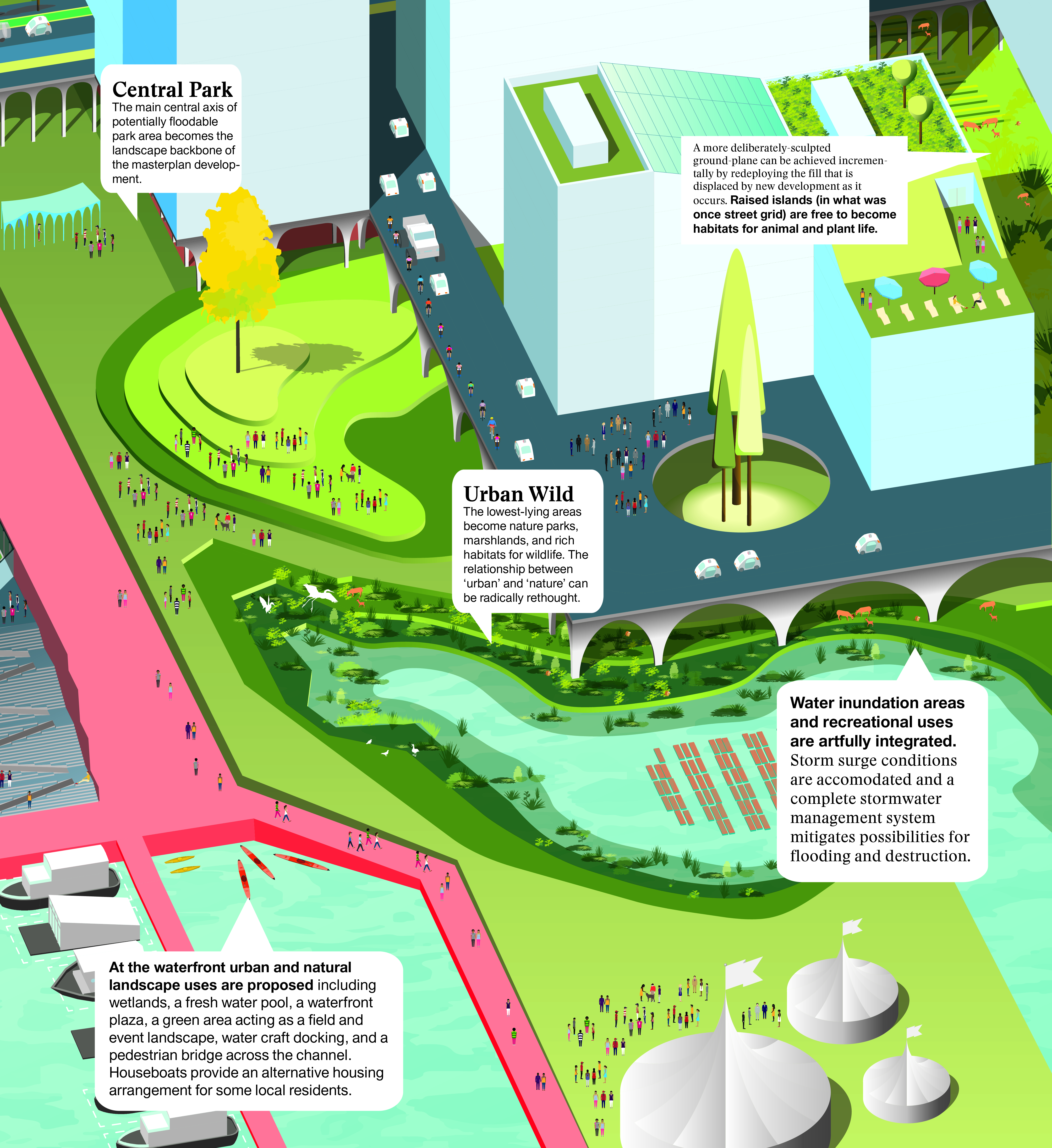
Living with Water is a project that represents a collaborative and strategic approach to design-led change in the face of climate instability in urban areas. An urban design and real estate strategy for Boston's low-lying Fort Point neighborhood contends with the inevitability of increased flooding in an era of climate crisis. A phased approach to district design and development gradually shifts the current context, largely filled with surface parking, to life above grade. The ground level becomes a floodable landscape.
Read a detailed analysis of the radically pragmatic strategy from the perspective of real estate and urban planning expert William Macht in ULI's Urban Land Magazine here.
In Phase I
The existing site is largely comprised of parking and hardscape, punctuated by historic industrial buildings that have shifted in use over time and are still loved as identifying elements of the neighborhood. New block and building types will use the highly flexible nature of the industrial building block as the jumping-off point for a new form of flexible urbanism.
Phase II
Future block types will be designed to host buildings with long lifecyles and a range of future use types to curb (or elongate) the wasteful building and demolition cycle. Near-term parking needs are accommodated in a mid-block parking deck with a retail perimeter at grade. As flooding makes ground level occupation challenging, the higher value leases will shift to the elevated courtyards, which will function as publicly-accessible social spaces in the near and long term future. Restaurants, retail, residential lobbies and other services will begin to populate the blocks, fronting onto the courtyard in the near-term future. This will serve to catalyze neighborhood identity and ease the transition to a fully elevated street network. These courtyards are linked to an evolving network of access bridges. A ground leasing strategy in which the ground level is opened up to public uses becomes the most viable scenario for ground level occupation when flooding becomes commonplace. Temporary or flexible programming such as markets, mobile food services, night clubs and parking are possible.
Phase III
A slowly emerging elevated neighborhood composed of heterogeneous blocks hosting courtyards with a range of identities is complemented by multi-tiered open spaces, consisting of new, “soft” tidal marshes at the water’s edge, flood-able spaces occupying former road networks, and elevated hardscapes used for pedestrian connectivity, views, and cultural expression.
The project was designed with Matthew Littell while working at Utile.
Role: Senior Designer and Project Manager, Utile, Inc.
Award: Living with Water Competition Out of the Box Award


